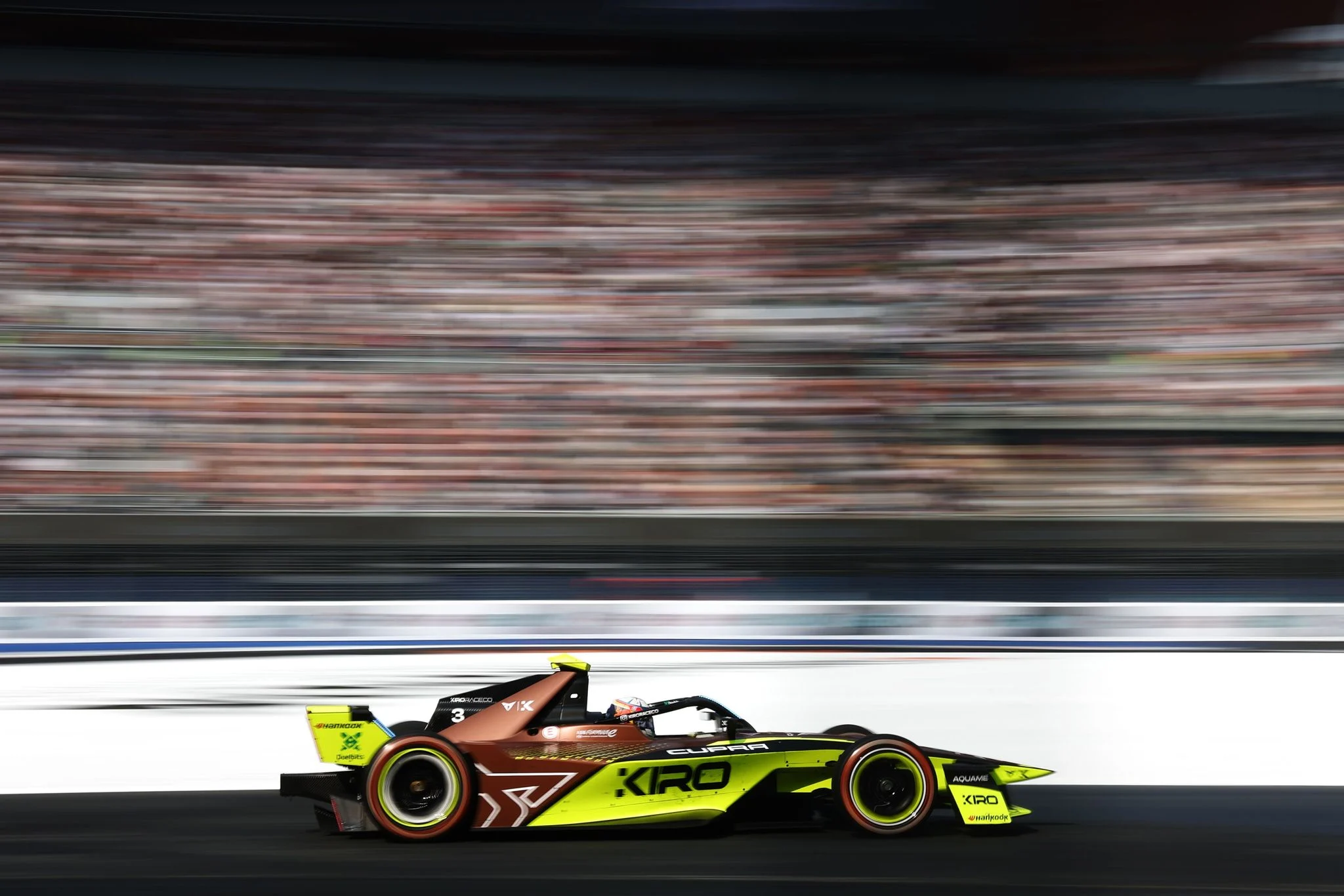
Midway through round two of his rookie season, Marti might reasonably have viewed it as another weekend simply to endure. His Formula E debut in Sao Paulo had ended in a frightening accident that sent his car airborne and rolling, while events in Mexico quickly compounded the difficulty.
He lost all running in second practice, then went into the race knowing he would have to serve a 10-second stop-and-go penalty following an inverter, MGU and gearbox change. By the end of the opening lap, Marti had already served that penalty – and rejoined the race 51 seconds adrift of the pack.
As Formula E strategist Albie Lau explained during the live broadcast, there is a recognised playbook for situations like this: save as much energy as possible, stay on the lead lap, protect the tyres – and hope for a safety car or red flag to reset the race.
So the first half of Marti’s race was about driving with restraint. Rather than chasing lap time, he circulated at reduced speed, prioritising efficiency and preserving energy.
Shortly before mid-distance, the opportunity he had been waiting for arrived. Nyck de Vries stopped in the Turn 1 runoff, triggering a full-course yellow that was soon upgraded to a safety car. At that moment, Marti held 7% more energy than team-mate Dan Ticktum and roughly 5–6% more than most of the grid. And he still had both Attack Mode activations unused.
That energy advantage transformed Marti’s race, but exploiting it still required careful execution. Formula E races are rarely predictable – something Marti knew all too well after Sao Paulo – and using too much energy too early would have left him exposed at the end.
His progress was initially measured. Even after a multi-car incident on lap 25 allowed him to gain four places in one move and climb to 13th, Marti still hadn’t recorded an average lap speed above 100km/h. Among the frontrunners, only Nick Cassidy, the eventual race winner, was following a similarly patient approach.
The contrast between phases of Marti’s race is stark. Over the first 21 laps, his top speed peaked at 206km/h. Across the following 17 laps, his average top speed jumped to 230.4km/h, with a peak of 242km/h on lap 29. His energy usage profile reflects that control.
Over the first half of the race, Marti averaged around 2.5% battery per lap. From lap 21 onward, consumption rose above 3% per lap almost consistently, peaking at 3.4% as he deployed his final Attack Mode and pushed hardest at the finish.
Marti opted for a split Attack Mode strategy of four minutes plus four minutes. Activating the first on lap 26, he immediately converted extra power and four-wheel drive into progress, charging into the points and reaching ninth by the end of that phase.
His final Attack Mode came in the closing laps, including two additional laps added to the race distance. In that decisive stint, Marti passed Norman Nato, Mitch Evans, and finally Nico Mueller on the last lap as Mueller’s Porsche ran out of usable energy.
There were some similarities between Marti’s drive and Cassidy’s race-winning performance. Cassidy was the second-biggest mover in the field, climbing from 13th to first, and the energy-percentage trends between the two runs are closely aligned.
Cassidy saved slightly less energy early on due to running higher up in the field, but spent it more aggressively in the second half of the race to seize the lead. Marti used his bigger advantage more progressively through the final third of the race.
That likely reflects a combination of experience – Cassidy is arguably the most accomplished energy manager in Formula E – and package differences.
While Marti runs a customer Porsche powertrain at Cupra Kiro, Cassidy races for Citroen, and how teams and drivers exploit those systems varies. Lap-time versus battery-usage data suggests Cassidy achieved slightly better efficiency and consistency at comparable lap times, hinting at marginally stronger execution.
Even so, this is comparing Marti against one of the category’s gold-standard reference points – and he did his own job remarkably well.
SCHEDULE: Where, when and how to watch or stream the 2026 Miami E-Prix, Round 3
After an action-packed start to Season 12, you haven't got long to wait until ABB Formula E returns to your screen, and this time, we're returning to The Magic City: Miami. We'll be visiting the Hard Rock Stadium for a trip around the Miami International Autodrome. US teams Andretti, CUPRA KIRO and DS PENSKE will be looking to put on a show for their home fans on Saturday 31 January 2026.
Find out more
UNMISSABLE: Watch the brand-new season of 'Driver' on Amazon Prime
CALENDAR: Here's every race set for the 2025/26 Formula E season
FOLLOW: Download the Formula E App on iOS or Android
TICKETS: Secure your grandstand seats and buy Formula E race tickets
HIGHLIGHTS: Catch up with every race from Formula E IN FULL
HOSPITALITY: Experience Formula E and world-class motorsport as a VIP